Queen II Collector’s Edition
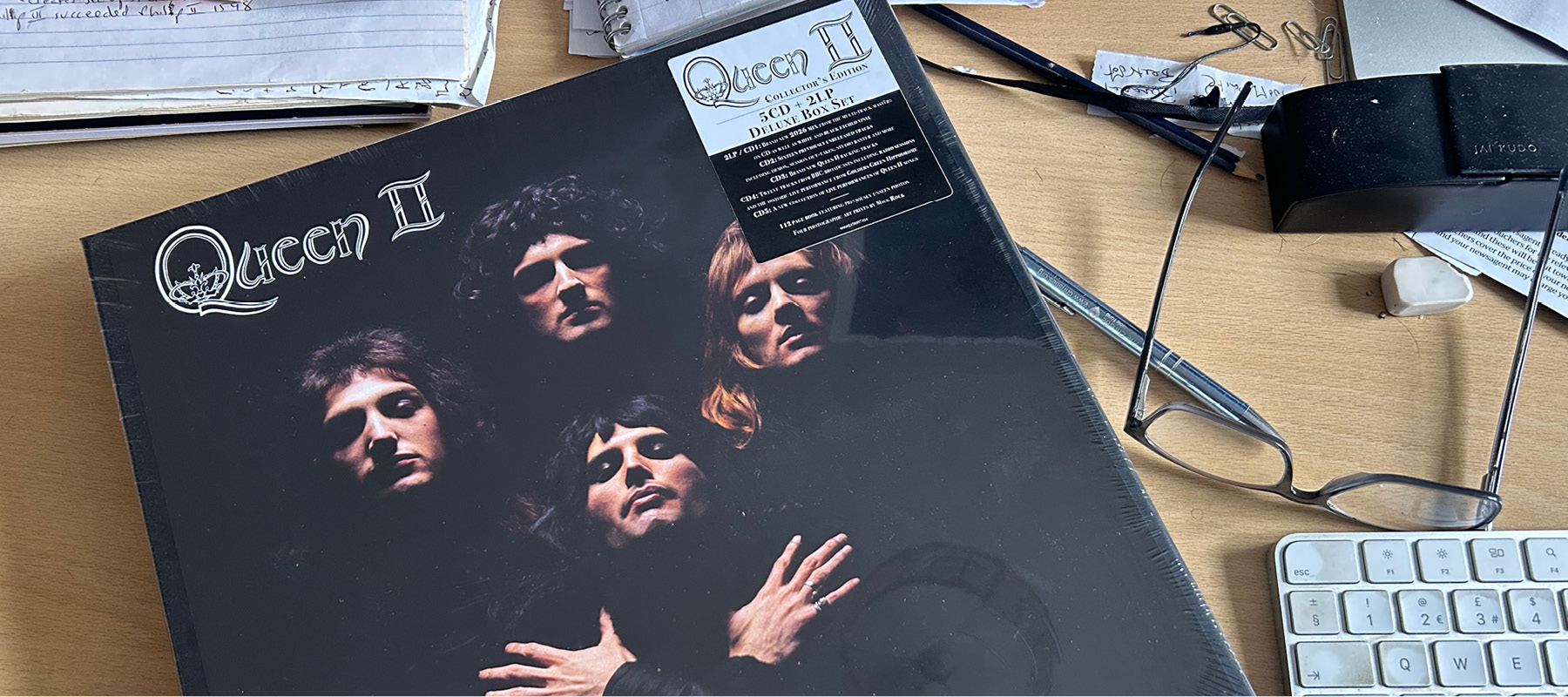
There were gaps of, respectively, five and two years between Queen’s first three studio-album collector’s editions – News of the World (2017), The Miracle (2022) and the renamed Queen I (2024). Now their fourth – Queen II – lands after just a seventeen-month hiatus.
This burst of activity is unusual for Queen these days – and there is a reason for it. Queen I and Queen II are in effect part of the same ‘rebuild’ project, to borrow guitarist Brian May’s favourite word of the moment. If you are unfamiliar with the background, you can find details in my Queen I review.
So, how good is this “rescued, restored, rebuilt, remastered version of Queen’s second album” – to quote Brian again. By the way, though he is fiercely protective of the entire Queen catalogue, it doesn’t take a genius to work out that Queen II is a particular favourite of his. He has very much taken the lead on this project, as indeed he does with most of the Queen legacy stuff. (Drummer Roger Taylor is probably busy holidaying on his yacht somewhere – again.)
Brian did a decent job of explaining the problems the Queen production team faced in a talk he gave at the launch event for the album in London on 26 March 2026, the day before its actual release. Unlike with the first album, the issue with Queen II was less to do with the sound of the instruments and more related to the limitations of studio technology back in the 1970s.
In simple terms – and I am certainly no expert – the band (and producer Roy Thomas Baker) were recording on sixteen-track tape. However, creating the multi-layered sound they were aiming for – the huge orchestration and choral effects that quickly became Queen’s trademark – required them to ‘bounce’ different tracks down to a single track. The snag was that each bounce caused a deterioration in quality, resulting in what Brian describes as a “muddy” and “soupy” sound.
Long story short, cutting-edge digital technology (no longer a tautology: we now have ‘modern’ and ‘old’ digital technology) enables them to thoroughly clean up the sound.
So, how good does it sound?
Putting to one side the question of whether pitch correction software has been used on Freddie Mercury’s vocals (and if it has, my amateur’s ears can’t detect it), I echo everything I said about the Queen I rebuild. It sounds AWESOME.
There is more bottom end, adding depth and power (check out Ogre Battle and Seven Seas of Rhye), the clarity is superb and the Atmos mix (I have mainly been listening to it via a streaming platform) brings to the fore plenty of musical doodlings and the like that either I simply haven’t noticed before or were so buried in the mix as to be inaudible on a cheap home sound system.
The battling ogres at roughly 3:00 of Ogre Battle, and the additional guitar flourishes in The Fairy Feller’s Master-Stroke at roughly 1:25 are just two of many examples of what I am referring to.
Music has an unerring ability to conjure up vivid mental snapshots of times, places and events long past. I first bought this album in 1978, nearly fifty years ago. And yet I can effortlessly picture myself in an armchair in the corner of our living room next to the music centre, headphones plugged in. There I am, lovingly handling and wiping the LP before carefully putting needle to vinyl. And now I am sitting back, devouring every word on the sleeve and lyric sheet and joyfully – wilfully – succumbing to the music.
My love for the album – as well as Sheer Heart Attack and those other early Queen LPs – grew with every play. Fast forward to 2026 and playing the new mix of this most familiar of albums was like hearing it for the very first time. What a rush to be spirited back across the decades to learn to love and appreciate it afresh.
My guess is that for many fans of early Queen this is one of their favourite albums, perhaps even their pick of the bunch. In my own ranking of Queen songs, compiled in 2018–19, five of my top-twenty were from Queen II: Nevermore, Father to Son, The Fairy Feller’s Master-Stroke, Seven Seas of Rhye and White Queen. And March of the Black Queen wasn’t far behind.
And judging by discussions on the Sea of Tranquility YouTube channel, it seems to be the go-to Queen album for prog fans. It is undoubtedly the band at their most ambitious (though A Night at the Opera runs it close), gamely tweaking and twiddling those studio knobs to their early-70s limits. I agree with Brian: for all that the first album was an impressive debut, Queen II was a huge step forward.
CD 2 is the sessions disc, featuring an early version of each track, usually either piano, bass and drums or guitar, bass and drums. These sessions CDs have been a highlight of all the studio box sets, offering us a fascinating insight into the band’s creative process. They are a must-have for any Queen geek.
There have been some genuine nuggets too. I loved the earthy middle section of Get Down Make Love (ultimately replaced by Brian’s harmonizer effects) from the News of the World sessions and the closing section of the song The Miracle on the 2022 box set of the same name.
Here a highlight is the improvised (?) closing section to Father to Son (what eventually became the long “Joyful the sound…” fade-out). And I was struck by how high Freddie was singing the heavier songs like Father to Son and Ogre Battle.
One YouTube critic was unimpressed with the inclusion of studio chatter, but I find it revealing, as long as we bear in mind that everything we hear comes with the band’s seal of approval – and Queen are notorious for not normally releasing anything they aren’t 100% happy with (the unreleased Earl’s Court 1977 video, to take just one example).
These selections certainly hammer home the message that recording Queen II was a laborious and exhausting process – of take after take to get everything just so. I laughed aloud at “Brian’s fucking around” (he must have been a nightmare to work with) and Freddie’s “That’s fucking terrible”, and John Deacon’s “Good luck, boys!” ahead of a run-through of the fiendish The Fairy Feller’s Master-Stroke also made me chuckle.
CD 2 also includes an early (1969) Brian demo of what would eventually become White Queen, a new mix of the excellent See What a Fool I’ve Been – a bluesy guitar-driven song that was the b-side of Seven Seas of Rhye, with Freddie camping it up to 11 – and a delightful Not for Sale, a re-recording of an old Smile song called Polar Bear.
The box set is available to buy from the official Queen store for an eye-watering £194.99. (I paid £180 on Amazon.) However, CDs 1 and 2 are also available as a standalone deluxe release. The question of whether the box set is value for money comes down, therefore, to what else it contains.
All of the studio box sets have included a CD of backing tracks; it is CD 3 of this particular collection. It is the one CD that I hardly ever return to after an initial play, though I get that hearing the songs without the lead vocal enables the listener to focus more easily on what is happening in the background and (in the case of early Queen in particular) savour the complexity. And I suppose it is a great addition for those who want to play or sing along.
So far, so good then, but for me the rest of the box set is something of a letdown. CDs 4 and 5 contain live material and four Queen II-related tracks taken from their various Radio 1 sessions. Excellent – except that there is literally nothing that has not already see the official light of day. That is quite the missed opportunity.
CD 4 is entitled Queen II – at the BBC. Well, a Queen on Air box set, containing everything on CD 4, was released in 2016. To be fair, the highlight is a concert from 13 September 1973 from Golders Green in London that only appeared on the 6-CD deluxe edition of Queen on Air, which is now expensive to get hold of.
It is the earliest broadcast of Queen in concert and, though Freddie is initially too low in the mix, a stunning recording. It includes early versions of Procession (already being used as a taped opener for the live show) and Father to Son.
The bad news is that they have again – as they did with Queen on Air – used the official BBC broadcast which fades out before the end of the show, meaning that we miss most of an outstanding rock ‘n’ roll medley that is widely available online. That’s annoying.
And CD 5 contains songs taken from their London Rainbow concerts in March and November 1974 (plus White Queen from Hammersmith 1975). Again, all of these have already been made available. Indeed, the outstanding Live at the Rainbow ’74 was their first box set, released in 2014.
So, what could they have included instead? Well, both nights at the Rainbow in November 1974 were recorded (and filmed). Perhaps they could have given us the ‘other’ version of each of the songs – ie the one that wasn’t used in the official release.
Or, what about some soundboard recordings? It is something they have done before (Sleeping on the Sidewalk, Doing All Right, Hangman). Presumably, there are recordings from 1974 and 1975, perhaps in Brian’s collection.
For context, the two encores in the Genesis The Lamb Lies Down on Broadway fiftieth-anniversary box set are soundboard recordings, and I read that at least some of the live recordings included as part of the Yes Tales from Topographic Oceans box set are from Steve Howe’s private collection. Pink Floyd, meanwhile, included an entire Mike Millard bootleg in the Wish You Were Here box set, and the recording – from Los Angeles in April 1975 – is now getting a standalone release.
To repeat, what a missed opportunity.
This Collector’s Edition also includes two heavyweight LPs – one in white vinyl and one in black vinyl to match the original labelling of the two sides of the album. The catch is that each LP features just one side of music (the other side is engraved).
And last of all there is a 112-page hardback book, featuring – to quote from the official press release – “track-by-track comments from May and Taylor, handwritten lyrics, archival interviews with Freddie Mercury and John Deacon, pictures of gig posters, adverts and studio tape boxes, plus photos…”.
If you have the Queen I box set, you will know what to expect. It is suitably lavish and contains lots of fascinating material for the committed Queen fan. On the other hand, there is a lot of filler to get it to 112 pages – do we really need 30 versions of the same photo shoot? – and, notwithstanding the comment in the press release, the track notes are somewhat limited.
(By the way – and making a purely historical point here, not a political one – I am pleased that the line “A little nigger sugar then a rub-a-dub-a baby oil” from The March of the Black Queen has been reproduced in the printed lyrics. The third word is omitted in the official lyric video.)
And I get really cross when I see typos in expensive publications. To give two examples, it was a bit disconcerting to see “It gave you a tremendous pallet” on the very first page (a ‘pallet’ is used on a forklift truck; the metaphor Roger is using relates to painters who use a ‘palette’). And they need to be consistent with their apostrophes – either straight or curly, but not a mix of the two.
Nitpicking perhaps, but it returns us to the question of value for money.
Let’s compare the prices of three recent box set releases (on Amazon – and, in the interests of fairness, I don’t know whether the price I quote was the price at time of release): Tales from Topographic Oceans by Yes (roughly £120), Grace Under Pressure by Rush (roughly £260) and Queen II.
Tales from Topographic Oceans: 12 CDs, two vinyl LPs and a Blu-ray audio, including several new mixes. The Blu-ray alone has (I am quoting) “a 2026 Dolby Atmos mix, a 2026 5.1 mix DTS-HD MA, a 2026 stereo remix, a 2026 stereo remaster and a 2026 instrumental mix”. I call that excellent value for money.
Grace Under Pressure: 4CD + Blu-ray, including a newly remastered version and a new stereo mix and a complete live concert (the Blu-ray includes a Dolby Atmos mix). Ridiculously expensive.
The Queen II box set – as a reminder, I paid £180 on Amazon but it was £194 from the official Queen shop at time of release – does not even include a Blu-ray with an Atmos mix. As with Queen I, it will be issued separately. And if they stick with their previous pricing strategy, the Blu-ray will set you back another £20 or so.
As I said above, CDs 1 and 2 are available as a standalone deluxe release – a more affordable option for those unable or unwilling to pay almost £200 for the full Collector’s Edition box set.
But putting the question of the box set’s value for money to one side for a moment, the remixed Queen II is essential listening, and perhaps best viewed as a companion piece with not just the remixed Queen I but also Live at the Rainbow ’74. Fans of this early iteration of Queen have much to enjoy.
Meanwhile, for those who only know the band from their later chart-friendly hits, it will doubtless come as a shock to discover just how hard Queen rocked in those early days.
Will we get a ‘rebuild’ of Sheer Heart Attack? It seems unlikely. Brian has indicated that they were happier with their studio sound by the time of the third album.
More’s the pity.