
My 100 Favourite Albums Ranked
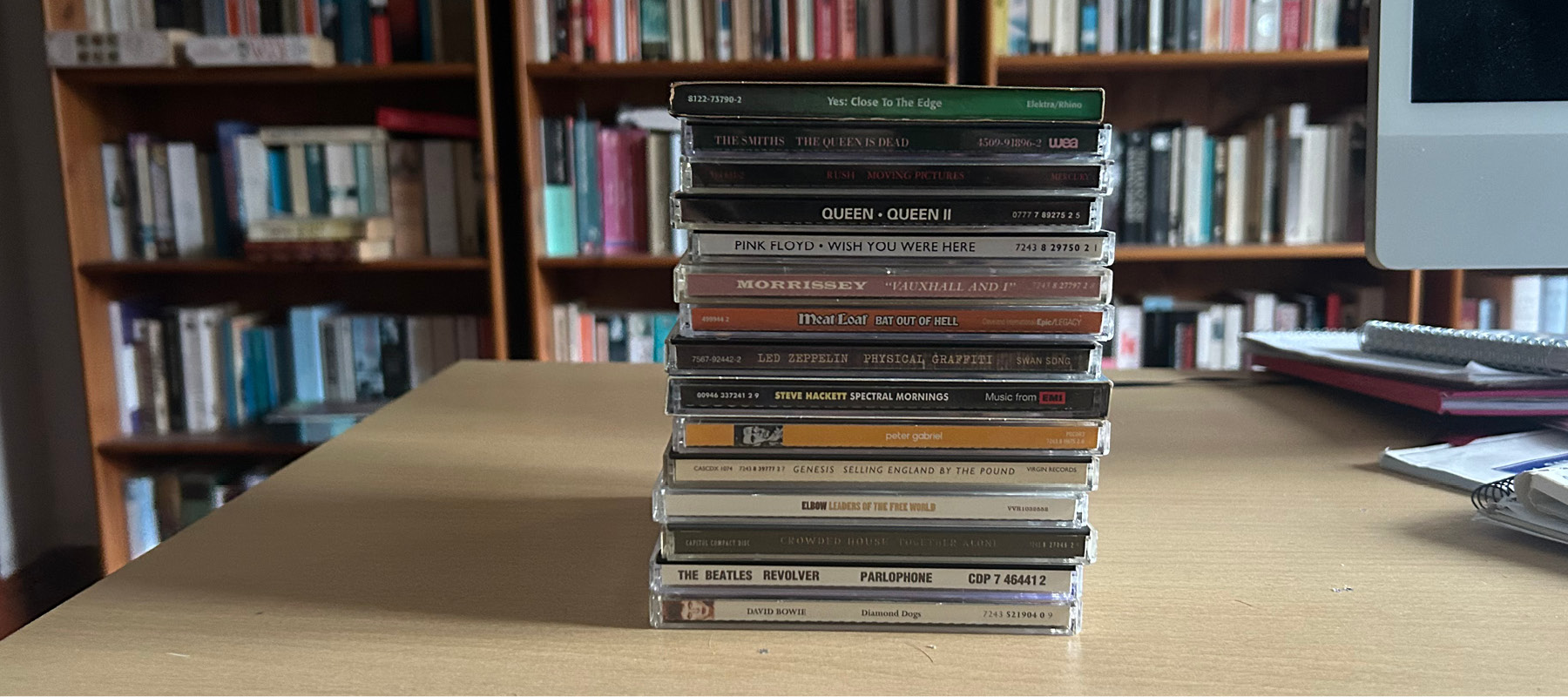
25. Peter Gabriel, untitled third album (1980)
The album often referred to as ‘Melt’. Although I loved the single Games Without Frontiers, it was a five-star review in Sounds that prompted me to buy this album. I like some of the tracks on his first two solo albums, but Gabriel really ups his game with this third release. We didn’t know it at the time but the opening track Intruder is the origin of one of the most recognisable musical tropes of the 80s – the ‘gated’ drum. This isn’t a concept album but there is undoubtedly an underlying lyrical theme – outsiders, whether the burglar (Intruder), the misfit (No Self-Control), the assassin (Family Snapshot) or the revolutionary (Biko). Gabriel famously takes forever to record albums. His work always repays close listening. He has an extraordinary musical mind.
Standout tracks: No Self-Control; Family Snapshot; Games Without Frontiers; Not One of Us; Biko
24. Simon and Garfunkel, Bridge Over Troubled Water (1970)
When I compiled a top-50 list in 1983, I put The Simon and Garfunkel Collection as my number one. (I think I had just bought the album and it was never off the turntable.) It isn’t eligible for this list (original studio albums only), but it is noteworthy that six of the eleven tracks on Bridge Over Troubled Water – Simon and Garfunkel’s magnificent swansong – featured on that single-album collection. That’s how good Bridge Over Troubled Water is.
What’s more, two of the other five tracks would not have disgraced the collection either. One is So Long, Frank Lloyd Wright, and the other is possibly their most overlooked gem – the autobiographical The Only Living Boy in New York. I find it so desperately moving – a friendship that is falling apart. The only puzzle is why such an outstanding poet-lyricist as Paul Simon feels the need to resort to “Doh-n-doh-de-doh-n-doh”. I also find myself wondering whether a song as extraordinary as Bridge Over Troubled Water is better as the opening or closing track. Given its rousing climax, I would have put it at the end and maybe started the album with the magnificent The Boxer.
Standout tracks: Bridge Over Troubled Water; Keep the Customer Satisfied; So Long, Frank Lloyd Wright; The Boxer; The Only Living Boy in New York
23. Coldplay, A Rush of Blood to the Head (2002)
I really like Coldplay’s debut album, Parachutes (2000), but this follow-up takes them to another level. How extraordinarily assured they sound – as if they were already writing songs for stadiums. The song In My Place strikes me as typical of early Coldplay – an insistent riff that leads into a big-hearted, feel-good chorus. It is a formula that – in songs such as Clocks, Warning Sign and A Whisper – they use repeatedly, and it also enables them to elevate even fairly run-of-the-mill songs like Politik and Daylight. I still buy – and enjoy – Coldplay albums but, like many bands, nothing matches the quality of their earliest work.
Standout tracks: In My Place; The Scientist; Clocks; Warning Sign; A Whisper
22. Elbow, The Seldom Seen Kid (2008)
This is something of a late switch. For a long time I was planning on putting their third album – Leaders of the Free World (2005) – in this list but changed my mind after another listen of both albums. Fuck, it’s a tough choice. Elbow’s music is intelligent and expressive and full of emotional heft. Take the opener, Starlings, about the sudden, explosive impact of falling in love. Or Weather to Fly, a gentle meditation on youthful energy and optimism. But The Seldom Seen Kid really makes its presence felt with the impressive run of songs on the second half of the album, from The Loneliness of a Tower Crane Driver onwards. The Fix makes me laugh, Some Riot makes me weep, One Day Like This makes me smile. What a poet Guy Garvey is.
Standout tracks: Weather to Fly; The Loneliness of a Tower Crane Driver; The Fix; Some Riot; One Day Like This
21. Styx, The Grand Illusion (1977)
It was Pete Pardo of the Sea of Tranquility YouTube channel who persuaded me to listen properly to Styx. They are one of the few bands on this list who feature twice and with consecutive albums. Styx were releasing albums in the early 70s, but they only really found their feet with Equinox (1975) and Crystal Ball (1976) – the latter album, in particular, could easily have been on this list. The Grand Illusion, released in January 1977, is their masterpiece – mainstream rock music of the very highest quality. Pieces of Eight (1978) – a bit lower down in this list – is almost as good. A band at the height of their powers.
Standout tracks: The Grand Illusion; Superstars; Come Sail Away; Man in the Wilderness; Castle Walls
20 Talking Heads, Fear of Music (1979)
When I glanced through Sounds magazine’s albums of the year for 1979, little did I know that more than forty-five years later I would be placing Fear of Music in my top-twenty favourite albums of all time. (It was their favourite release of the year.)
First things first, it is – like all of the Talking Heads albums – fundamentally a collection of really catchy and clever songs. Clearly, they were not afraid to experiment, though tracks like I Zimbra, Paper and Life During Wartime further accentuate the rhythmic feel of much of the second album. Best of all, Fear of Music has the fingerprints of producer Brian Eno all over it. Working alongside fellow genius David Byrne, the result is both weird and wonderful. The album is a treat for the ears, especially now that it can be heard in Dolby Atmos.
Standout tracks: Mind; Paper; Life During Wartime; Air; Heaven
19. David Bowie, Low (1977)
Sound and Vision, the first single from Low and released in February 1977, was possibly the first David Bowie song I was ever aware of. (I must have heard one or two others before then, but without knowing they were by him.) It piqued my interest because it was so unusual – it’s short, the vocal doesn’t start until halfway through and Bowie’s delivery is a bit odd. When I eventually bought Low, I found it heavy-going, particularly side two. This was not the Bowie of Life on Mars, Suffragette City and Drive-in Saturday.
And that’s rather the point. Bowie was an actor and musical chameleon par excellence – the master of reinvention. Ziggy was long gone. So too the Thin White Duke. Low was the first of his Berlin trilogy, recorded in the literal and metaphorical shadow of the Berlin Wall rather than under the bright lights of hedonistic Los Angeles. The sound was heavily influenced by producer Tony Visconti and collaborator Brian Eno, and draws on the electronic/ambient style of German bands such as Tangerine Dream and Kraftwerk. Lots of the New Romantic bands of the 80s credit Bowie as a formative influence, but his work was much more avant garde. Truly, a 70s album that never sounds dated.
Standout tracks: Speed of Life; Sound and Vision; Be My Wife; Warszawa; Art Decade
18. The Beatles, Revolver (1966)
I didn’t mind the early Beatles stuff – of the two big collections I think I preferred the Red Album to the Blue Album – but I never seriously entertained the idea of buying any of those first few albums from Please Please Me (1963) to Help (1965). Everything changes with Rubber Soul (1965) and Revolver, the two albums which I think of as the bridge between ‘early’ and ‘later’ Beatles. Both albums document the Beatles perfecting their songwriting craft. Fourteen high-quality songs delivered in thirty-five minutes; not a second of vinyl time goes to waste.
Much is made of the seminality of Tomorrow Never Knows, John Lennon’s drug-enhanced experiment in using the studio as an instrument. It’s the final track (though apparently the first one recorded) – a signpost to what was to come. But the whole album is groundbreaking, with all five members of the band – I’m including producer George Martin – at the top of their game. It is extraordinary that only two tracks from Revolver (and none of the ones listed below) featured on the Red Album.
Standout tracks: Taxman; I’m Only Sleeping; Here, There and Everywhere; Good Day Sunshine; And Your Bird Can Sing
17. Pink Floyd, Wish You Were Here (1975)
Wish You Were Here was, by all accounts, a ‘difficult’ album. No wonder. How do you follow up the huge worldwide success of The Dark Side of the Moon (1973)? Their answer was by not doing a Dark Side Part II. The 25-minute Shine On You Crazy Diamond, divided into two parts and used to open and close the album, is (like the 23-minute Echoes from Meddle) mainly an instrumental piece. Just three other tracks (one of which isn’t sung by a member of the band) make up the album. The band were clearly not chasing commercial success.
The lyrical themes that emerged – alienation and detachment, disillusionment and moral indignation – reflected the prevailing mood in the wake of the success of the previous album and went on to define Pink Floyd for the next decade, until Rogers Waters’ departure from the band. For once, the Hipgnosis cover art wasn’t too difficult to decipher – a business deal in which one of the participants is (literally) burnt.
As noted above, Waters dismissed the ‘upper fifth-form’ lyrics of The Dark Side of the Moon. For Wish You Were here he wrote arguably his finest lyrics. Shine On You Crazy Diamond is his tribute to Syd Barrett: “Come on you target for faraway laughter / Come on you stranger, you legend, you martyr, and shine!” As chance would have it, Barrett visited Abbey Road Studios unannounced, near the end of the sessions (how did he get past security, one wonders?) and was barely recognisable.
All the ‘mature’ Pink Floyd albums sound great. The 2025 Dolby Atmos mix of Wish You Were Here really is wonderful.
Standout tracks: Shine On You Crazy Diamond; Wish You Were Here
16. Yes, The Yes Album (1971)
For a long time this was pencilled in as my number-one Yes album. On reflection, it yields the top spot to another, if only on the basis that one crucial ingredient in the classic Yes mix is missing: Rick Wakeman. What the album does have, however, is the debut appearance of Steve Howe, whose scintillating contributions helped to transform the Yes sound and enabled them to experiment with ever more ambitious pieces of music. (Wakeman’s arrival by the time of the next album, Fragile, had a similar ratcheting effect, I would argue.)
Songs such as Yours Is No Disgrace, I’ve Seen All Good People and Perpetual Change became staples of the live show but the album’s highlight (and another live staple) is arguably Starship Trooper. The acoustic Clap is another Howe masterclass, though it is odd that the album includes a live – and not particularly well recorded – version and not the slightly longer studio recording (which features part of what became another song, Mood for a Day, at the end – perhaps that’s the reason).
Standout tracks: Yours Is No Disgrace; Starship Trooper; Perpetual Change
15. Rush, A Farewell to Kings (1977)
The sleeve notes on Rush’s 1976 live album All the World’s a Stage – great title! – include the statement that the album “signifies the end of the beginning, a milestone to mark the close of chapter one, in the annals of Rush”. A Farewell to Kings opened chapter two. The most obvious progression was the introduction of keyboards – sparingly, at first – to the band’s sound.
There is a distinctly medieval/pre-industrial feel to A Farewell to Kings – the lovely acoustic introduction recorded in the open air, the lyrical references to blacksmiths, madrigals and Rocinante (from Don Quixote) – and yet paradoxically the album closes with a voyage into deep space and an encounter with a black hole. The lyrics of the title track resonate even more powerfully in the 2020s than they did in the mid-70s – “The hypocrites are slandering the sacred halls of truth” – and the words of Closer to the Heart are up there with Neil Peart’s finest. And if there is a better side of vinyl than the original side one, I can’t think of it.
Standout tracks: A Farewell to Kings; Xanadu; Closer to the Heart; Cygnus X-1
14. Supertramp, Crime of the Century (1974)
I could kick myself for how late I got to this album. I discovered – and really liked – Supertramp as a kid, but for some reason (probably because money was tight and, as they weren’t really a rock band, buying Supertramp albums was definitely not a priority) I never got further than listening to Even in the Quietest Moments (1977) and Breakfast in America (1979). A schoolboy error, literally.
Fast-forward a lot of years and I eventually corrected this oversight, buying their entire back catalogue. Crisis? What Crisis? (1975) is a great album (though recorded in a rush, I believe), but Crime of the Century is their masterpiece. It features a very different line-up from the one that recorded their second – and rather bewildering – album, Indelibly Stamped (1971). Roger Hodgson and Rick Davies remain the core of the group but the addition of John Helliwell, in particular, brings an extra dimension to the band’s sound.
If anyone argues that Supertramp were a prog band, they will probably cite Crime of the Century as evidence. It certainly has an unconventionality and quirkiness that is one element of prog music. It also has a cohesiveness that Indelibly Stamped completely lacks. Despite a run of high-quality albums stretching to Famous Last Words (1982), most of the tracks on Crime of the Century remained in their live set almost a decade later, until the point that Hodgson left the band.
Standout tracks: School; Hide in Your Shell; Asylum; Dreamer; Crime of the Century
13. The Smiths, The Queen Is Dead (1986)
There isn’t, alas, a huge amount of really good live footage of the Smiths. The best – just two songs – only lasts about seven minutes: their appearance on Whistle Test in May 1986 performing Bigmouth Strikes Again and Vicar in a Tutu. The band’s sound had been (temporarily) beefed up by the addition of Craig Gannon as a second guitarist on stage, but the star of the show was undoubtedly Morrissey, playing the part of irrepressible indie icon to perfection.
It was recorded a month before the release of The Queen Is Dead. How relaxed and confident they looked, given not only that bassist Andy Rourke had been sacked for drug-taking and then rehired but also that the album’s release had been delayed by months because of record-company wrangles. Were they aware of the impact their new album would have? It is often cited (in sympathetic circles) as the best album of the 80s and one of the greatest indie albums of all time.
Johnny Marr is at his creative peak and Morrissey at his playful best, his lyrics taking us from deep despair (I Know It’s Over) to farcical comedy (Vicar in a Tutu). There Is a Light That Never Goes Out is surely their defining song, the one for which they will always be known.
Standout tracks: The Queen Is Dead; I Know It’s Over; Cemetry Gates; Bigmouth Strikes Again; There Is a Light That Never Goes Out
12. The Stone Roses, The Stone Roses (1989)
The Smiths were without doubt the greatest indie band of the 80s, but the best indie album of the 80s was arguably this one – the debut album by the Stone Roses. Maybe the indie world was looking for a pick-me-up after the Smiths break-up. It found it with the ‘Madchester’ scene and this album captured the vibe perfectly.
Earlier songs Sally Cinnamon and Elephant Stone were great singles from 1987 and 1988 respectively, but ironically – given that it is now so highly acclaimed – the debut album initially received relatively little attention.
The album is an exhilarating dance/rave/indie mash-up, packed with great grooves and scintillating melodies. Reni and Mani are the glue holding everything together, while Ian Brown is just about managing to hold his vocals together (unlike on stage). But what truly sets this album apart is the contribution of John Squire on guitar – inventive, exploratory, mesmeric. I Am the Resurrection is a sonic masterpiece. As well as everything else it might be, this is a guitar album.
The band released a (very) long-awaited second album in 1994, but in truth their moment disappeared as quickly as it had first appeared. True, Fool’s Gold became a club classic when it was released later in 1989 and One Love was a decent single, released after their huge gig in Spike Island. But nothing – and certainly nothing from the second album – matched the quality of their debut.
Standout tracks: I Wanna Be Adored; She Bangs the Drum; Waterfall; Made of Stone; I Am the Resurrection
11. The Beatles, Abbey Road (1969)
The Beatles’ swan song. Let It Be was only released in 1970, after the band had officially split up, but it was recorded before the Abbey Road sessions. How ironic that the beating heart of Abbey Road should be a wonderful medley of songs, given that the band itself was so clearly fracturing. And without wanting to go down the rabbit hole of hidden messages and meanings, the iconic album cover is itself fascinating – the four members walking (almost) in lockstep, yet with no interaction or communication between them.
John Lennon and Paul McCartney of course do the heavy lifting in terms of songwriting, but Abbey Road features two of George Harrison’s finest Beatles songs – Something and Here Comes the Sun – and Octopus’s Garden is Ringo Starr’s best song and vocal contribution too. Lennon apparently hated McCartney’s “granny music” but I think Maxwell’s Silver Hammer is great, if a little lightweight. Come Together is often cited as one of Lennon’s best songs, but I prefer the intensity of I Want You (She’s So Heavy). Side two is just wonderful – the Beatles at their very best.
Standout tracks: Something; Here Comes the Sun; the medley
10. Pink Floyd, Animals (1977)
Mention Britain in the 70s and it is TV shows like The Sweeney and The Professionals that immediately come to my mind, particularly the frantic car chases that were usually executed amidst the rubble and detritus of a decaying, deindustrialised London. The iconic cover of Pink Floyd’s Animals depicts Battersea Power Station (plus flying pig) in the London of that era. The music, meanwhile, is a bleak and despairing document of a society in political, economic and (particularly) moral decline.
The music (and the musicianship) is, it goes without saying, terrific but – like him or loathe him – it is Roger Waters whose conceptual conceit truly elevates Animals. His Orwell-esque allegories systematically dissect and then skewer the dominant culture and mores that so evidently repulse him. It is chilling and deeply cynical – but always mesmerising.
Richard Wright was increasingly marginalised as the years went by – to the point that he was not actually credited as a member of the band on The Final Cut (1983). The excellent 2018 remix of the album (after Wright’s death) gives greater prominence to his keyboards. David Gilmour wrings outstanding solos out of his guitar at the close of Pigs (Three Different Ones) and Sheep. The ‘Lord Is My Shepherd’ section of Sheep doesn’t quite work, but it is still – along with Comfortably Numb – my favourite Pink Floyd track.
Standout tracks: Dogs; Sheep
9. Genesis, Wind and Wuthering (1976)
Tony Banks regards Wind and Wuthering as one of his favourite Genesis albums, which is perhaps not too much of a surprise, given that – from the opening notes of Eleventh Earl of Mar – his keyboards dominate song after song. The album, he says, offers some of Genesis’s most complex music – “about as far from three-chord rock as you can get”.
Listening to Wind and Wuthering is a richly rewarding listening experience. Banks has described the music as “yearning” and “romantic” and there is certainly atmosphere and melodrama aplenty, as we embark on a musical adventure that takes us from the rebellious Scottish highlands of the eighteenth century to the windswept moors of northern England.
Highlights include One for the Vine and Afterglow, both of which became live favourites. The first took a year to write, apparently; the other took as long to write as it does to listen to. Blood on the Rooftops, which was never played live, is another standout moment and possibly Steve Hackett’s finest writing contribution to the band. Mike Rutherford has called it their “forgotten song”.
Genesis went on to release a live album – Seconds Out (1977) – recorded in Paris near the end of the Wind and Wuthering world tour. It is a stunning album, though ironically most of the songs from Wind and Wuthering were omitted to fit the set onto four sides of vinyl.
Standout tracks: Eleventh Earl of Mar; One for the Vine; Blood on the Rooftops; Unquiet Slumber for the Sleepers… / …In That Quiet Earth; Afterglow
8. Queen, A Night at the Opera (1975)
For anyone curious about early Queen, A Night at the Opera is the album I always recommend. It is the band’s Sgt Pepper. The story goes that new manager John Reid suggested they go into the studio and just focus on making the best record they possibly could while he got on with the job of extricating them from their existing – deeply unsatisfactory – contracts. (Death on Two Legs leaves the listener in little doubt about Freddie Mercury’s opinion of the band’s former management.) Another story is that it became – at that point in time – the most expensive album ever recorded.
Certainly, Queen (with the enthusiastic support of whizz-kid producer Roy Thomas Baker) were attempting to use the studio to the maximum, just as the Beatles had done. In other respects, A Night at the Opera brings Abbey Road to mind. Side one may not be a medley but – with seven tracks in almost exactly 20 minutes – the listener has little time to draw breath. The breadth of musical styles is simply astonishing – rock, pop, folk, music hall and more.
Side two takes things much more slowly. Unusually for Queen, there are just four tracks (plus a rendition of God Save the Queen). Three of the four are in my all-time Queen top ten. It is the best, most complete side of a Queen vinyl album.
There are so many wonderful moments on A Night at the Opera, from the opening piano to the closing gong. Everyone hails Bohemian Rhapsody, of course – and rightly so – but The Prophet’s Song is just as ambitious and just as good. A bit niche, perhaps, but my favourite moment is Roger Taylor’s backing vocals during ’39.
Standout tracks: Death on Two Legs (Dedicated to…); ’39; The Prophet’s Song; Good Company; Bohemian Rhapsody
7. Yes, Close to the Edge (1972)
The ultimate prog rock fan’s prog rock album.
Getting Steve Howe on board for The Yes Album (1971) was crucial for the evolution of the band’s sound. The addition of keyboard wizard Rick Wakeman for the Fragile (1971) album was the final critical ingredient. Fragile has plenty of wonderful moments – Roundabout, South Side of the Sky, Heart of the Sunrise – but the inclusion of several essentially solo pieces makes it a somewhat bitty listen. It is on Close to the Edge that the band truly cohere – ironic, as drummer Bill Bruford quit before the album was even released.
Close to the Edge has a level of ambition that earlier tracks like Heart of the Sunrise were hinting at. The side-length title track is divided into four musically dense and intricate sections, and includes a wonderful pipe organ interlude from Wakeman. And You and I dials down the intensity and Siberian Khatru closes the album in a more traditional rock style. Jon Anderson’s lyrics, meanwhile, reach new heights of metaphorical abstraction. Who would have thought that And You and I was a protest song?
All three songs have remained staples of the Yes show to this day. And no wonder.
Standout tracks: Close to the Edge; And You and I
6. David Bowie, Hunky Dory (1971)
David Bowie’s really big (albeit somewhat manufactured) breakthrough came in 1972 with the Ziggy Stardust album, but I have always preferred the preceding release, Hunky Dory. Maybe it’s because Life on Mars and Changes were two of the first Bowie songs I ever heard. I still never tire of listening to them.
As I later discovered, Bowie was already making waves by the time Hunky Dory came out, though stardom had stubbornly eluded him in the 60s. The unconventional single Space Oddity had been a top-five hit at around the time of the first Moon landing in July 1969, and The Man Who Sold the World (1970) album has plenty of great moments on it, notably Width of a Circle and the title track, as well as a (for its time) shockingly transgressive sleeve.
Guitarist Mick Ronson, whose guitars gave The Man Who Sold the World a satisfyingly rough edge, was still on board for Hunky Dory, though the latter album has a mellower and more acoustic feel. (And not many albums appearing consecutively on this list involve the same musician: Rick Wakeman played keyboards on Hunky Dory, presumably just before he joined Yes.)
Bowie aims high with Hunky Dory. The references to John Lennon, Andy Warhol and Bob Dylan remind us that he was desperate to become part of the cultural avant garde. Quicksand, meanwhile, name-checks Greta Garbo, Aleister Crowley and Heinrich Himmler, among others. Elsewhere – on Kooks and Fill Your Heart specifically – there is still a playfulness and youthful idealism to his writing that (presumably) touring, drugs and the relentless demands of stardom soon disposed of.
Standout tracks: Changes; Oh! You Pretty Things; Life on Mars; Quicksand; Queen Bitch
5. Led Zeppelin, Physical Graffiti (1975)
The year 1975 was the turning-point for Led Zeppelin, and not in a good way. As I have written elsewhere, it wasn’t simply that nothing they did musically after 1975 was as good as what they had produced before (though that is to a certain extent true – and undoubtedly the opinion of many Led Zeppelin fans). The bigger point is that everything – in and out of the studio, on and off stage – began to go wrong, with ultimately tragic results. And yet, ironically, the year had started so well – another mega-tour of North America, a triumphant return to England (five sell-out shows at Earls Court) and the release of what has become their most acclaimed album.
Eight of the Physical Graffiti’s fifteen tracks were new; the other seven were resurrected from earlier sessions to expand the available material to the length of a double album. This decision to trawl through the vaults was entirely vindicated by the quality of some of those previously rejected tracks (particularly The Rover, Houses of the Holy and Bron-Yr-Aur). It gave the band room to experiment with a range of musical styles that was wider than ever.
If the question for Led Zeppelin fans in, say, 1974, was how do the band follow up five hugely successful and often groundbreaking albums, I wonder how many would have responded: by releasing a double-album’s worth of new music. Physical Graffiti has the swagger of a band who believed they could not put a foot wrong.
Standout tracks: The Rover; In My Time of Dying; Kashmir; Bron-Yr-Aur; Ten Years Gone; Sick Again
4. Queen, Sheer Heart Attack (1974)
Queen are my favourite band. They have always been my favourite band. As I have written elsewhere, A Day at the Races (1976) was the first ‘proper’ album I ever bought, at some point in 1977. I then worked my way backwards through the Queen catalogue – A Night at the Opera (1975) and then Sheer Heart Attack and so on. Not that I would have fully grasped it at the time (I wasn’t even a teenager at this point), but buying the albums in reverse order meant that I didn’t immediately appreciate how the Queen sound developed in those early years and, in particular that – after the intensity of Queen II (1974) – Sheer Heart Attack takes the listener on a more varied musical journey.
Sheer Heart Attack was recorded under difficult circumstances. A tour of the USA supporting Mott the Hoople had to be cut short after Brian May was struck down with hepatitis. Weeks later he was diagnosed with a duodenal ulcer. As a consequence, much of the preparation and early recording of Sheer Heart Attack was done in May’s absence. The sleeve notes tell us that John Deacon played “almost all guitars” on the track Misfire (the first Queen song written by him), and the May tracks Dear Friends and She Makes Me (Stormtrooper in Stilettos) feel like songs written and largely recorded in isolation.
Unlike Queen II, Sheer Heart Attack – though similarly musically adventurous and satisfyingly multi-layered – resists the temptation to shoehorn absolutely everything into every track. The emphasis is more on experimentation and variety (something that immediately became a Queen hallmark, at least in the studio) and less on density of sound. May later recalled that he had been worried at the time that Killer Queen – which became their first worldwide hit – was rather light. And in its own way Freddie Mercury’s vaudevillian Bring Back That Leroy Brown became – in its very outlandishness – as typical of the Queen sound as the more obvious rock songs like Now I’m Here.
Brighton Rock replaced Son and Daughter as a home for May’s extended guitar solo on stage and is my favourite Queen song. In the Lap of the Gods…Revisited closed the main set for three years and (for this fan at least) was an even better show-closer than We Are the Champions.
Standout tracks: Brighton Rock; Killer Queen; Flick of the Wrist; She Makes Me (Stormtrooper in Stilettos); In the Lap of the Gods…Revisited
3. Rush, Moving Pictures (1981)
Rush released nineteen studio albums between 1974 and 2012. That’s a hefty catalogue of songs, a fair few musical styles and several identifiable band ‘eras’. What’s striking is that most Rush fans – regardless of what ‘era’ of the band is their favourite or when they first discovered Rush – cite Moving Pictures as their number-one album. Striking, too, that even many die-hard fans of (early) ‘classic’ Rush do not demur. And striking for a third reason as well – the most obvious gateway album for listeners new to a band is one that the aforementioned die-hard fans consider the best.
Permanent Waves (1980) demonstrated that Rush were willing and able to move with the times. After the prog-rock classics A Farewell to Kings (1977) and Hemispheres (1978), The Spirit of Radio’s opening riff heralded a decade of musical invention and experimentation. Meandering multi-layered epics such as Xanadu and Cygnus-X1 (and before that The Fountain of Lamneth and 2112) were replaced by shorter, streamlined, more ‘accessible’ songs.
Everything fell perfectly into place on Moving Pictures. The album not only has several of their most revered songs but also sounds great. In particular, it achieves a judicious balance between guitars and keyboards that is sadly lacking on the next album.
Opening tracks often come to define albums. Moving Pictures opens with Tom Sawyer – long a fan favourite and a track that took on new significance following the death of Neil Peart. (The song contains his most iconic drum fill.) YYZ is probably their go-to instrumental and Limelight is possibly Alex Lifeson’s best solo, simply because it so perfectly echoes the emotion of the lyrics.
The original side two was always overshadowed by side one. Arguably, in recent years – perhaps since the Time Machine tour in 2011 when the album was played in full – it seems to have been getting the attention it merits. Witch Hunt is not really a hidden gem (it is too well known and was often played live) but it could just be my Rush top-ten wild card.
Standout tracks: Tom Sawyer; YYZ; Limelight; The Camera Eye; Witch Hunt
2. Genesis, Selling England by the Pound (1973)
For most longtime fans this is ‘classic’ Genesis: the Tony Banks / Phil Collins / Peter Gabriel / Steve Hackett / Mike Rutherford line-up. It is the era of the Mellotron and twelve-string guitars, of fox heads and old-man masks, of hermaphrodites and hogweed.
There is something quintessentially English about early Genesis, their music a curious but compelling admixture of pastoral tones and textures, prog-rock excess and absurdist humour à la Monty Python.
It all comes together gloriously on Selling England by the Pound. The opening track – Dancing with the Moonlit Night – even had Peter Gabriel dressed (on stage) as Britannia. It is – along with Firth of Fifth and The Cinema Show – one of three bona fide Genesis classics on this album. The best of the best.
I love the track sequencing on Selling England, epic tracks interspersed with moments of light relief that give the listener much-needed space to breathe. The majestic Dancing with the Moonlit Night is followed by the silliness of I Know What I Like, which became their first hit single. After the tour de force that is Firth of Fifth comes the simple More Fool Me, with Phil Collins on vocal.
Side two hurls us back into the thick of it – almost literally – with The Battle of Epping Forest, a tale of warring East End gangs. The pace and intensity of the (musical) action is echoed in Gabriel’s lyrics, which (though playful and witty) could do with some serious editing. No wonder the next track, After the Ordeal, was an instrumental.
No album is perfect. Selling England by the Pound has its flaws and perhaps over-reaches at times, as does their next album, The Lamb Lies Down on Broadway (1975). But, oh, what a joy to listen to.
Standout tracks: Dancing with the Moonlit Night; Firth of Fifth; The Cinema Show
1. Queen, Queen II (1974)
Queen II would be near the top of any list of albums that best exemplify excess and over-reach. After being forced to record their first album in ‘down time’ (odd, often anti-social, hours when nobody else needed the studio) Queen and producer Roy Thomas Baker made full use of the studio time available for the follow-up to create those huge orchestration and choral effects that quickly became the band’s trademark.
Their first hit single, Seven Seas of Rhye, is typical. After the prolonged, meandering opening to the band’s first single, Keep Yourself Alive, Seven Seas of Rhye took them to the other extreme — delivering everything bar the kitchen sink in a spellbinding opening thirty seconds.
Or, take Father to Son. An appropriately guitar-rich epic, this is Brian May’s loving tribute to his father, Harold, with whom he built the Red Special. The centrepiece is May’s sweeping, multi-layered solo, yet the whole song illustrates the prevailing Queen motif — to fill every possible space with sound, right from the opening power chords.
Or, how about The March of the Black Queen? It’s impossible to listen to Bohemian Rhapsody and not hear echoes of Black Queen. The most over-the-top track on Queen’s most over-the-top album. The listener is left gasping at their sheer arrogance: it feels as if every so-far unused musical idea from the sessions was added to the mix. It almost keels over under the weight of its grandiosity. It is audacious, outrageous and utterly magnificent.
In my ranking of Queen songs that I compiled in 2018–19, five of my top-twenty were from Queen II, with a sixth not far behind.
And so, for today at least, Queen II is my favourite album. And the excellent 2026 mix (“rebuild”) enables the listener to hear the album in crystal-clear sound, without the distortion and muddiness that resulted from the limitations of the recording technology available in the early-70s.
Standout tracks: Father to Son; White Queen (As It Began); The Fairy Feller’s Master-Stroke; Nevermore; The March of the Black Queen; Seven Seas of Rhye


Great list and an enjoyable read!
If I had to nitpick (which I will) I’m surprised to see All Mod Cons make an appearance and with Sound affects not getting a mention.
Thank not just for reading the blog but also for taking the time to comment. It really is much appreciated.
The Jam were one of a number of groups where I picked one album to represent several. With them, it came down to a choice between All Mod Cons, Setting Sons and Sound Affects. I listened to all three albums a couple of times before making my pick. I just think All Mod Cons hangs together better. Sound Affects is a bit…well, bitty. Plus All Mod Cons has Tube Station on it.
Excellent pal. Some classics there buddy!
Thanks for taking the time to read it, pal! It is very much appreciated. Apologies for the slow progress so far – I was writing the companion piece at the same time. Hopefully it won’t be too long until I get it finished!