
My 100 Favourite Albums Ranked
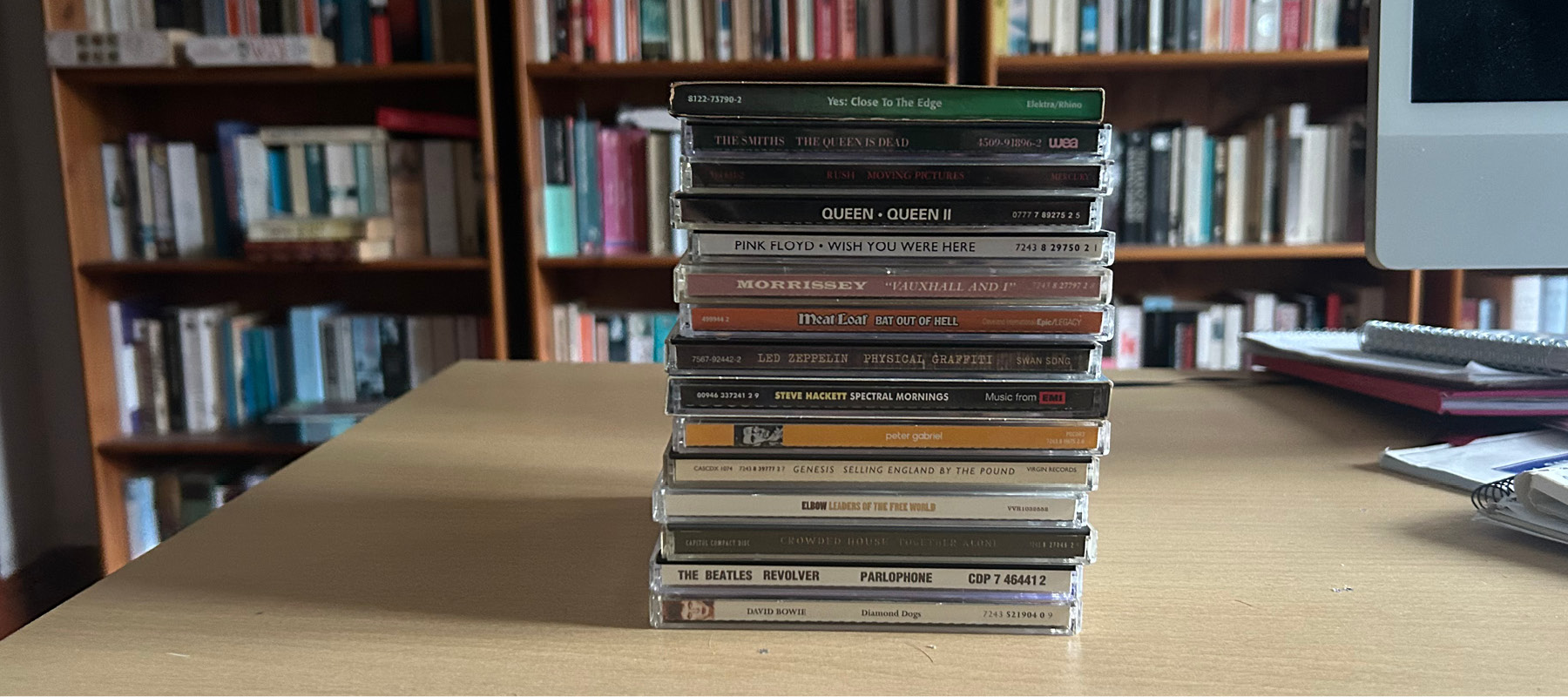
50. Morrissey, Your Arsenal (1992)
With the aid of producer and ex-Spider from Mars Mick Ronson, who introduced a decidedly early-70s glam vibe to the proceedings, Your Arsenal (Your arse ‘n’ all – ho ho) was a triumphant return to form for Morrissey after the underwhelming and somewhat lacklustre Kill Uncle (1991). Ever the contrarian, Morrissey has a track record of releasing some of his weaker songs as singles. It’s fair to say that tracks 5–7 – Certain People I Know, We Hate It When Our Friends Become Successful and You’re the One for Me, Fatty – are not the best songs on this album. I Know It’s Gonna Happen Someday could be a Bowie song; indeed, Bowie covered it almost immediately for his Black Tie, White Noise album.
Seasick, Yet Still Docked is one of my favourite Morrissey songs. The emotional punch of the lines “My love is as sharp as a needle in your eye / You must be such a fool to pass me by” is matched a few bars later by an achingly beautiful descending bass line (reminiscent of the downbeat closing music to The Sweeney television programme) as the song draws to a close.
Standout tracks: You’re Gonna Need Someone on Your Side; The National Front Disco; Seasick, Yet Still Docked; Tomorrow
49. The Cranberries, No Need to Argue (1994)
My introduction to the Cranberries was the sublime Linger from Everybody Else Is Doing It, So Why Can’t We? (1993). It’s an excellent debut album but this follow-up surpasses it in quality. The entire world knows Zombie (which I was more than a little surprised to see recently listed in a Halloween playlist) but the grungy guitar sound isn’t typical of the album as a whole. While No Need to Argue is rockier than the first album, the best tracks tend to be the acoustically driven ones, the guitars nicely complementing Dolores O’Riordan’s angelic voice. Alas, their later albums were not as captivating as these first two.
Standout tracks: Ode to My Family; Twenty One; Zombie; Ridiculous Thoughts
48. Supertramp, Breakfast in America (1979)
Supertramp appeared on my musical radar in 1977 because of the enchanting single Give a Little Bit and a chance hearing of the epic Fool’s Overture on daytime Radio 1. The Logical Song came along in 1979, another slice of Roger Hodgson magic. That single – and the accompanying album Breakfast in America – gave them worldwide commercial success. If 1977’s Even in the Quietest Moments… is their pastoral album – acoustic guitar, chirping birds and the rest – Breakfast in America’s signature sound is the Wurlitzer electric piano, which dominates tracks such as the Logical Song, Child of Vision and the title track itself, and reinforces the sense of quirkiness that makes Supertramp such an intriguing band.
Standout tracks: The Logical Song; Goodbye Stranger; Take the Long Way Home; Child of Vision
47. Billy Bragg, Don’t Try This at Home (1991)
Despite my interest in politics and my indie leanings, I kept Billy Bragg at arm’s length during the 80s. Music with the lefty politics turned up to eleven struck me as too unsubtle, didactic and ‘right on’. I wasn’t even aware that he was now recording with a backing band, and so the single Sexuality (1991) was a pleasant surprise – catchy, uplifting, tongue in cheek and super-smart.
Don’t Try This at Home finds Bragg playing in the big league. Guest musicians include Johnny Marr – who co-wrote Sexuality – and Peter Buck (from REM). It is ambitious (sixteen tracks, including two covers, and nearly an hour’s worth of music) and, on the whole, wonderful. There is plenty of politics here, of course, but often it is Bragg’s writing about life itself – parents, ageing, relationships, children – that I find most affecting. It is why I continue to buy his stuff to this day. The lyrics of Tank Park Salute (about the death of his father) always move me to tears: “You were so tall / How could you fall?”
Standout tracks: Accident Waiting to Happen; You Woke Up My Neighbourhood; Sexuality; Mother of the Bride; Wish You Were Her
46. Led Zeppelin, untitled fourth album (1971)
How many Led Zeppelin albums to put in this list? I have settled for two – one early, one late. If Houses of the Holy (1973) is the midpoint of Zeppelin’s career, the (famously untitled) fourth album is my favourite of the early albums. The other great early album, Led Zeppelin II (1969), sounds a bit dated in places, and I much prefer the production on the fourth album. The original side one is magnificent and – though I am not overly keen on Misty Mountain Hop and Four Sticks (listening to which always brings to mind the dreaded George Harrison ‘sitar’ tracks on Revolver and Sgt Pepper) – side two ends gloriously with Going to California and When the Levee Breaks.
Standout tracks: Black Dog; The Battle of Evermore; Stairway to Heaven; Going to California
45. Steve Hackett, Spectral Mornings (1979)
Spectral Mornings was the first Steve Hackett I bought – more or less at time of release, I think – and indeed it is the only Hackett album I owned until taking a chance on The Night Siren in 2017 (which appears earlier in this list). I immediately warmed to Spectral Mornings, so I am rather at a loss as to why I didn’t then buy his first two solo albums, released in 1975 and 1978 respectively. It is such a varied album that – like all Hackett’s later releases – draws inspiration, musically and lyrically, from history and particularly geography. The opening track Every Day, still a staple of the live show, is my favourite Hackett solo song.
Standout tracks: Every Day; Clocks – the Angel of Mons; Lost Time in Córdoba; Spectral Mornings
44. REM, Green (1988)
The IRS label released Eponymous, a magnificent compilation of standout early REM tracks, in October 1988 and then just weeks later the band released Green, their first album on the Warner Bros label. Their record label wasn’t the only thing that was changing. Musically and lyrically, the band were continuing to experiment and evolve. For example, from the album’s very title to the songs themselves, there is a markedly more political feel to Green. There is also an arena-ready vibe to songs such as Pop Song 89 and Get Up. Losing My Religion (from the band’s next album, Out of Time, 1991) must be a contender for the greatest rock song to feature a mandolin, but that instrument also helps define the sound of Green, notably on the wonderful You Are the Everything.
Standout tracks: Pop Song 89; Get Up; You Are the Everything; Orange Crush; untitled eleventh track
43. The Housemartins, London 0 Hull 4 (1986)
The Housemartins only released two studio albums, but what stonkers they were. I could just as easily have picked The People Who Grinned Themselves to Death (1987) but opted for their less-polished debut, if only because its rebellious spirit – “Take Jesus – Take Marx – Take Hope” – is accentuated by its very rawness. This is indie pop-rock at its infectious best, packed with attitude and an in-your-face directness that is perfectly exemplified by the opening lines of the band’s debut single, Flag Day: “Too many Florence Nightingales / Not enough Robin Hoods”. As well as the two studio albums, Now That’s What I Call Quite Good (1988) is an excellent collection of singles, b-sides and radio-session recordings (though ineligible for this list).
Standout tracks: Happy Hour; Flag Day; Reverends Revenge; Sheep; We’re Not Deep
42. Scorpions, Lovedrive (1979)
Taken by Force (1977, featured earlier in this list) and Lovedrive are consecutive Scorpions albums – their fifth and sixth respectively – but they represent two different eras of the band. Taken by Force was the last to feature Uli Jon Roth, whose distinctive approach to guitar-playing – experimental, psychedelic, Hendrix-esque – defined the early Scorpions sound. The Tokyo Tapes live double-album, released to acclaim in 1978, is his glorious swansong. Lovedrive offers a more polished studio sound, combining hard rock with radio-friendly choruses – and with a sideline in outstanding power ballads, none more so than Always Somewhere. Lovedrive and the follow-up, Animal Magnetism (1980) are the band’s best two albums, though they had more commercial success in the 80s.
Standout tracks: Loving You Sunday Morning; Always Somewhere; Coast to Coast; Lovedrive; Holiday
41. Supergrass, Supergrass (1999)
Supergrass released six outstanding albums but arguably never quite made it to the really big league – headlining Glastonbury, for example. That being said, they undoubtedly made a huge splash with their first album, I Should Coco (1995), and particularly the single Alright. In It for the Money (1997) was a great follow-up but their third album is my favourite. There’s still plenty of playful laddishness and humping on stereos to enjoy, but there is also a more serious and experimental feel to the music as a whole. Their final three albums also took some interesting musical detours, not least the foot-stomping glam-rock vibe of Diamond Hoo Ha (2008). When they did a thirtieth-anniversary tour for I Should Coco in 2025, Gaz Coombes was introducing Alright as “Track 4”.
Standout tracks: Your Love; What Went Wrong (In Your Head); Beautiful People; Eon; Mary;
40, Radiohead, OK Computer (1997)
Certain albums can be relied on to appear in the upper reaches of music journalists’ and critics’ lists of greatest albums. Pet Sounds (1966) by the Beach Boys is one. This is another. I listened to it – and its predecessor, The Bends (1995) – just to see what the fuss was about. Now I know. I really wanted to include both albums in this list. Alas, no room. The Bends and (particularly) OK Computer are densely layered (to quote Wikipedia) sonic masterpieces – gloriously messy and discordant. I have yet to delve deeper into Radiohead’s back catalogue. Is it possible that they have recorded other material that matches the quality of these two albums?
Standout tracks: Paranoid Android; Let Down; Karma Police; Electioneering
39. Coldplay, X&Y (2005)
As someone who made no effort to keep up with new music in the Noughties, I was only vaguely conscious of Coldplay. They struck me as the U2 of the day – big sound, big hits, big audiences. I think it was the Speed of Sound single and its wonderful chorus that prompted me to investigate more closely, and so I bought their (then) three albums. X&Y – their third – contains several hit singles, as do the first two, but it is striking how consistently excellent the album is across an hour or so of music (hidden track not included). It is also noticeable how literally – on tracks like Talk – they sound like U2.
Standout tracks: Square One; White Shadows; Talk; Speed of Sound; The Hardest Part
38. The Smiths, Meat Is Murder (1985)
The 80s was the decade when the fashion for twelve-inch singles, usually featuring three or four tracks, took off. The Smiths were one of a handful of bands who were so brilliant or so arrogant – or both – that many of their best songs didn’t appear on studio albums at all. Exhibit A: the 1984 non-album single William, It Was Really Nothing, which also featured Please, Please, Please, Let Me Get What I Want and How Soon Is Now (many Smiths fans’ favourite song). Those tracks were recorded at roughly the same time as the band were recording their second album, Meat Is Murder.
How unfortunate that the recording of the first Smiths album, The Smiths (1984), was so badly botched. How can so many great songs sound so dull? The opening seconds of Meat Is Murder are enough to reassure us that the same mistakes have not been made again. The Headmaster Ritual – like all Smiths songs – is credited to Morrissey and Marr, but it is Andy Rourke’s bass lines that immediately hook in the listener. Aside from its great songs, what makes Meat Is Murder a genuine standout album is its breadth of musical styles.
Standout tracks: The Headmaster Ritual; That Joke Isn’t Funny Anymore; Nowhere fast; Well I Wonder; Meat Is Murder
37. Emerson, Lake and Palmer, Brain Salad Surgery (1973)
I was aware of ELP as a child for two reasons. The ‘Welcome back my friends…’ line from Karn Evil 9 was used in the introduction to Alan Freeman’s Saturday Rock Show on Radio 1, and an edited version of Fanfare for the Common Man was an unexpected hit for ELP in 1977. Memories of the song snippet and of the video – recorded on a freezingly cold day at the Olympic Stadium in Montreal – lingered in my memory long after any interest I might have had in ELP’s music melted away. I couldn’t possibly like a band who didn’t seem to have a guitarist. It was decades later that I took a chance on a ridiculously cheap two-CD collection, part of the excellent The Essential… series. It did the job admirably, the shorter, more accessible tracks my gateway to the deeper cuts. I went full-in and bought their entire 70s output (up to Works Vols I and II) in one go.
They are all great albums (I wanted to include 1972’s Trilogy in this list as well), but Brain Salad Surgery is undoubtedly the band’s masterpiece. Jerusalem is an inspired choice as opener, Toccata a showcase for their musical dexterity, Still… You Turn Me On another of Greg Lake’s haunting acoustic love songs, and Benny the Bouncer a brief playful interlude. The centrepiece – across thirty minutes and three ‘impressions’, one of which is itself split into two parts to spread the piece across two sides of vinyl – is the epic Karn Evil 9.
Standout tracks: Jerusalem; Karn Evil 9
36. Pink Floyd, The Dark Side of the Moon (1973)
My copy of the CD doesn’t include the definite article on the spine but the band’s own website does – so The Dark Side of the Moon it is. Side two of Meddle (1971) – the twenty-three-minute track Echoes – had already foreshadowed what was to come musically, but The Dark Side of the Moon nevertheless still represents a significant step forward for Pink Floyd. Roger Waters may have dismissed the ‘upper fifth-form’ lyrics but there is a consistency and maturity to the album, held together by a compelling central theme, that wasn’t evident on previous albums. In other words, there’s no Alan’s Psychedelic Breakfast (from Atom Heart Mother) or Seamus (from Meddle) to spoil the show.
The Dark Side of the Moon is often referred to as a ‘classic’ album, so it feels somewhat sacrilegious to place it so low down in this list. But keep scrolling and you will see that there are other Pink Floyd albums I prefer. I also think the album sounds a bit dated in places and plods at times (On the Run goes on too long and, unlike everyone else apparently, I am not particularly a fan of Us and Them).
Standout tracks: Breathe (In the Air); Time; Money; Brain Damage; Eclipse
35. Oasis, (What’s the Story) Morning Glory (1995)
Oasis were another band – see my comments above about the Smiths’ Meat Is Murder – who released umpteen ridiculously good songs only as b-sides. Songs like Talk Tonight, Rockin’ Chair and The Masterplan were all b-sides of singles taken from this album. And Acquiesce – the b-side of Some Might Say – is my favourite Oasis song of them all. Noel Gallagher, it seemed, could do no wrong at this point, not just writing all the band’s songs but also recording and co-producing the Morning Glory album in double-quick time.
Roll with It, the single released to promote the album, may have lost the so-called ‘Battle of Britpop’ to Blur’s Country House, but Oasis undoubtedly won the war. The singles Wonderwall and Don’t Look Back in Anger became the musical backdrop to 1996, helping (What’s the Story) Morning Glory become one of the all-time best-selling albums in the UK. I have never been a particular fan of the title track, but Champagne Supernova is a glorious way to close the album.
Standout tracks: Wonderwall; Don’t Look Back in Anger; Some Might Say; She’s Electric; Champagne Supernova
34. David Bowie, Diamond Dogs (1974)
Diamond Dogs is one of the first non-Queen albums I ever bought and almost certainly the first album by a solo artist as opposed to a band. My timeline may be a bit out, but I had heard and was obsessed by Life on Mars (we are talking late-77, I think) and I liked Sound and Vision, the first single from the Low (1977) album, and the song Heroes. I also knew Rebel Rebel – the guitar riff is pretty memorable, you have to say – but it was the only track on Diamond Dogs that I did recognise. I don’t think I had heard the name Ziggy Stardust at this point, but quite why I bought Diamond Dogs and not Hunky Dory (1971) I don’t know – maybe it was cheap in a sale.
I didn’t know what to make of the album at first. It was only a few years later that I started to understand the Orwellian references and the concept of a dystopia, so at first I thought of the album as nothing more than a collection of discrete – and fairly weird – songs. As I became more aware of Bowie as both a creative genius and an accomplished showman, I started to appreciate the brilliance of the Sweet Thing suite and the theatrical potential of the music as a whole. I regard Big Brother as one of his most underrated songs.
Standout tracks: Diamond Dogs; Sweet Thing (suite); Rebel Rebel; We Are the Dead; Big Brother
33. Joe Jackson, Blaze of Glory (1989)
I knew very little about Joe Jackson in 1989. Blaze of Glory is an album that I took a chance on, based on a five-star review. Perhaps I was looking for an artist to fill the void left by David Bowie, who seemed by this point to have forgotten how to write a decent song. According to the sleeve, Blaze of Glory is “dedicated to my generation”, which aligns with the Wikipedia comment that the album is “an examination of [Jackson’s] generation as the 1980s were ending”. This was, of course, the period when the communist regimes of eastern Europe collapsed and we dared to hope that the Cold War was a thing of the past. Within just a few months of the release of Blaze of Glory, the Berlin Wall itself had come down.
If Best Ofs are not your thing, then Blaze of Glory is a brilliant way to introduce yourself to a mature-sounding Joe Jackson. Musically, it is extraordinarily eclectic. I soon discovered that Jackson had a penchant for experimenting with musical styles from one album to the next. With Blaze of Glory, he brings it all together in one place. Lyrically, too, he ranges widely – from the social to the political, from the younger perspective to the older, and from the optimist to the pessimist.
Standout tracks: Tomorrow’s World; Me and You (Against the World); Sentimental Thing; Acropolis Now; Evil Empire
32. Yes, Going for the One (1977)
One of my early music memories is of a TV advert proclaiming that the advertised band sold out stadiums in the USA. The band was Yes and the advert was for the album Going for the One, released in July 1977. I bought the Going for the One single a few months later and then – later still – an imported (and therefore cheaper) copy of the Going for the One album.
It was only later, as I learned more about Yes, that I understood how Going for the One fits into the band’s musical evolution. What mattered at the time was that it was the perfect introduction for me to their music. Recorded as the punk explosion was beginning to transform not just the musical terrain but ‘pop’ culture more generally, the album delivers a much more accessible Yes after the density and complexity of the music on Close to the Edge (1972), Tales from Topographic Oceans (1973) and Relayer (1974). Even some of Jon Anderson’s lyrics made sense. And after leaving the band after the Topographic Oceans album and tour, Rick Wakeman was back, providing some of the album’s many outstanding moments (the piano in Turn of the Century; the church organ in Parallels). Side two, in particular, is a masterpiece: Wonderous Stories is beautiful and Awaken sublime.
Standout tracks: Going for the One; Wonderous Stories; Awaken
31. Genesis, Nursery Cryme (1971)
This is the first of three Genesis albums to feature in this list. I wanted something to represent the band in their earliest phase (basically, up to the Genesis Live album, which was released in 1973). Trespass (1970) is a great debut album (yes, I know it isn’t strictly speaking their first album) but Nursery Cryme was the first to feature the ‘classic’ line-up of Banks, Collins, Gabriel, Hackett and Rutherford, so it had to be either this album or Foxtrot (1972).
The latter has its legions of admirers, of course, but I have always leaned towards Nursery Cryme. The ingredients of – to use the word again – ‘classic’ Genesis are already all present and correct – from grand story-telling to a very English eccentricity, from gentle acoustic interludes to passages of dramatic intensity. The album’s judicious balance between longer and shorter pieces ensures that nothing outstays its welcome for even a moment.
Standout tracks: The Musical Box; The Return of the Giant Hogweed; Harold the Barrel; Harlequin; The Fountain of Salmacis
30. Arctic Monkeys, Whatever People Say I Am, That’s What I’m Not (2006)
I was (very) late to the Arctic Monkeys party – nothing changes – so I can only imagine that it must have felt like a Led Zeppelin or Stone Roses moment when this album came out. It’s a game-changer of a debut. The music is fast and furious, the lyrics well observed and razor-sharp. It isn’t often that song lyrics make me weep and then laugh out loud, but Alex Turner’s words and vocal delivery are on point throughout. As a child of the 70s, I salute the references to Frank Spencer and Roxanne. Speaking of which, When the Sun Goes Down is a worthy successor to the Police single as a song about prostitution: “…she must be fucking freezin’ / Scantily clad beneath the clear night sky / It don’t stop in the winter, no”.
Standout tracks: I Bet You Look Good on the Dancefloor; Still Take You Home; Riot Van; Mardy Bum; When the Sun Goes Down
29. REM, Automatic for the People (1992)
The song Losing My Religion made such an impression on me when it was released that I thought initially of putting Out of Time (1991) on this list as my second REM pick. Out of Time also features other wonderful tracks in addition to Losing My Religion – Near Wild Heaven, Endgame, Shiny Happy People, Texarkana. On the other hand, it also includes several tracks that I find somewhat plodding. It really has to be Automatic for the People, doesn’t it?
The album took a while to grow on me. I was rather underwhelmed at first, perhaps because the first single – Drive – wasn’t Losing My Religion Part II. I like Drive, but Man on the Moon would have been a much more ‘commercial’ choice.
Everybody Hurts also struck me as a magical song straight from the off. (Alas, I have heard it far too many times now and the magic has dissipated somewhat.) And if they wrote a better song than Losing My Religion then it is Find the River.
I have read countless times that the band are exploring darker themes on this album. Maybe, but Michael Stipe’s lyrics are often so obscurely phrased that I wouldn’t like to say. REM didn’t promote the album with a full tour, so if for no other reason than this I tend to think of Automatic for the People as the band’s Sgt Pepper.
Standout tracks: Everybody Hurts; Sweetness Follows; Monty Got a Raw Deal; Man on the Moon; Find the River
28. Talking Heads, Talking Heads: 77 (1977)
If the term ‘art rock’ defines a genre or subgenre of music, then later-Talking Heads fit snugly into the category. I was introduced to their music at university in the mid-80s. By this point, their albums – Remain in Light (1980); Speaking in Tongues (1983) – featured a veritable army of additional musicians and their live show (as documented in the brilliant Stop Making Sense film) resembled a painstakingly choreographed piece of theatre.
Talking Heads: 77 takes us back to the beginning and a sparser sound. The music has a heavy dance/funk influence and is super-catchy. My original CD sounded a bit dull but Dolby Atmos has transformed the listening experience. Every note, every snare is captured and reproduced with stunning clarity. Despite the weight of some of the songs, there is also a directness and a youthful innocence at work on this album – perhaps best exemplified by David Byrne’s introduction to the very first song on their live album The name of This Band Is Talking Heads: “The name of this song is New Feeling. That’s what it’s about.”
Standout tracks: Uh-Oh, Love Comes to Town; The Book I Read; Don’t Worry About the Government; Psycho Killer; Pulled Up
27. Styx, Pieces of Eight (1978)
Of all the American AOR bands of the 70s – the likes of Boston, Kansas and REO Speedwagon – Styx are my favourite. And if you are a fan of early-Queen (as I am) then there is so much to enjoy in Styx’s music from that era. I was aware of – and didn’t much like – the Styx megahit Babe from 1979. My interest in the band began with – and, for a long time was limited to – the single The Best of Times and the album Paradise Theatre (1981), which I had as a laser-etched disc (unusual for me, as I don’t tend to go in for gimmicky products). It was only decades later that I began to explore their back catalogue.
Pieces of Eight is the fourth in a sequence of outstanding albums, beginning with Equinox (1975). After the punchy opener, Great White Hope, there is a lighter feel to the tracks I’m O.K. and (particularly) Sing for the Day. A short mood piece then leads into a run of songs from Lords of the Ring to the song Pieces of Eight that is 70s mainstream rock music of the highest quality. The guitar solo and then the bridge (with accompanying feedback) on the title track is spine-tinglingly good: “Day into night / She’s with me / Turn of a card / She is there”. What a singer Dennis DeYoung is. And who but an American band could possibly get away with rhyming ‘duel’ and ‘fool’?
Standout tracks: Lords of the Ring; Blue Collar Man (Long Nights); Queen of Spades; Renegade; Pieces of Eight
26. Morrissey, Vauxhall and I (1994)
Although Your Arsenal (1992) was a critical and commercial success – particularly in America where Morrissey became the darling of college and independent radio – the so-called ‘Madstock’ episode in August 1992 (NME headline – ‘Flying the flag or flirting with disaster?’) and a growing fascination with violent imagery caused considerable disquiet among some of his fans and (particularly) once-fawning journalists. No longer, it seemed, was Morrissey infallible.
His next move was Vauxhall and I, his most accomplished album. Band member Alain Whyte co-wrote most of the tracks on Your Arsenal. In contrast, the best tracks on Vauxhall and I are co-written by Boz Boorer. Producer Steve Lillywhite brings a much softer feel to things after the sharper edges of Your Arsenal. True, the unsettling lyrical references haven’t gone away. To take just the opening two tracks, Dallow, Spicer, Pinkie and Cubitt are thugs from the Graham Greene book Brighton Rock, and Spring-Heeled Jim is a gangster whose age has caught up with him. But I can forgive him when the ugliness comes with music this good.
Standout tracks: Now My Heart Is Full; Spring-Heeled Jim; Billy Budd; Lifeguard Sleeping, Girl Drowning; Speedway
Great list and an enjoyable read!
If I had to nitpick (which I will) I’m surprised to see All Mod Cons make an appearance and with Sound affects not getting a mention.
Thank not just for reading the blog but also for taking the time to comment. It really is much appreciated.
The Jam were one of a number of groups where I picked one album to represent several. With them, it came down to a choice between All Mod Cons, Setting Sons and Sound Affects. I listened to all three albums a couple of times before making my pick. I just think All Mod Cons hangs together better. Sound Affects is a bit…well, bitty. Plus All Mod Cons has Tube Station on it.
Excellent pal. Some classics there buddy!
Thanks for taking the time to read it, pal! It is very much appreciated. Apologies for the slow progress so far – I was writing the companion piece at the same time. Hopefully it won’t be too long until I get it finished!